What this search is really asking
When people type orca slicer github softfever, they are rarely looking for a feature tour. They are trying to answer a tighter set of origin questions:
- Who is SoftFever relative to the OrcaSlicer project?
- Which repository and release channel should count as authentic?
- How does the community contribute without turning every mirror into a trusted source?
- After you trust a build, what should you lock down for printer and filament profiles?
This page is a practical evaluation guide for those questions. It is written for FDM hobbyists, multi-brand fleet owners, Klipper/Voron builders, and small print-shop operators who need a clean authenticity path before they touch slicer settings.
Disclosure: this guide is published by the team behind Orca Slicer, an independent verification-first resource hub for OrcaSlicer workflows. We are not the official OrcaSlicer project, we do not host installer binaries here, and you should always confirm downloads against the project’s own release surfaces.
SoftFever and the official OrcaSlicer project
Treat SoftFever as the maintainer identity people associate with the OrcaSlicer open-source slicer lineage on GitHub. In search results and community discussion, “SoftFever” usually points to the person or account behind the project’s public development trail, while “OrcaSlicer” is the product name of the slicer itself.
That distinction matters:
Label | What it usually means | What it does not automatically prove |
|---|---|---|
SoftFever | Maintainer / origin identity tied to the project’s public development presence | That every site, fork, or “SoftFever download” mirror is legitimate |
OrcaSlicer | The slicer product and its public project surface | That a lookalike domain is official just because it uses the product name |
GitHub repository + Releases | The normal place open-source desktop builds and source history live | That every fork, mirror, or renamed repo is the same project |
Use only this relationship model unless you can verify a stronger claim yourself:
- SoftFever is the origin identity associated with OrcaSlicer development.
- The public project is expected to expose source history, issues, pull requests, and release artifacts from its authentic repository surface.
- Branding that reuses “Orca”, “OrcaSlicer”, or “SoftFever” outside that verified surface is not automatically trustworthy.
Because live external verification was unavailable for this draft, this page deliberately avoids inventing repository URLs, star counts, version numbers, contributor totals, or release dates. Use the checklist below on the live project surfaces you open in your own browser.
Where releases actually live
For an open-source desktop slicer like OrcaSlicer, authentic distribution almost always follows the same pattern:
- Source of truth: the project’s primary GitHub repository.
- Installable artifacts: the repository’s Releases (or an official channel the repository itself documents).
- Ongoing development signals: issues, pull requests, release notes, and tagged commits connected to that same repository.
- Optional mirrors: package managers, community scripts, or third-party download pages that only stay trustworthy when they point back to the same release identity.
Practical rule: prefer the release asset that is published by the project’s own release channel and matches the repository identity you already verified. If a page offers an installer but never shows how it maps to a tagged release, treat it as unverified marketing until proven otherwise.
Stable versus experimental builds
Most active slicer projects publish more than one channel:
- Stable / tagged releases for day-to-day printing.
- Pre-release, beta, or nightly builds for testers who accept breakage.
If your goal is a working production profile stack—especially across a mixed fleet—default to a stable tagged release unless you intentionally need a pre-release fix. Experimental builds are useful for diagnosis; they are a poor default for a print shop floor.
What “community contributes” means in practice
Contribution on a project like this is usually not a second secret download site. It is the normal open-source loop:
- bug reports and reproduction notes in issues
- pull requests for fixes, profiles, translations, or tooling
- release notes and discussion around tagged builds
- downstream packaging (Flatpak, package managers, community install scripts) that still must map back to an authentic release
A helpful contribution path does not replace authenticity checks. A PR, a fork, or a “community build” page can be valuable and still be the wrong place to grab a binary for a shop machine.
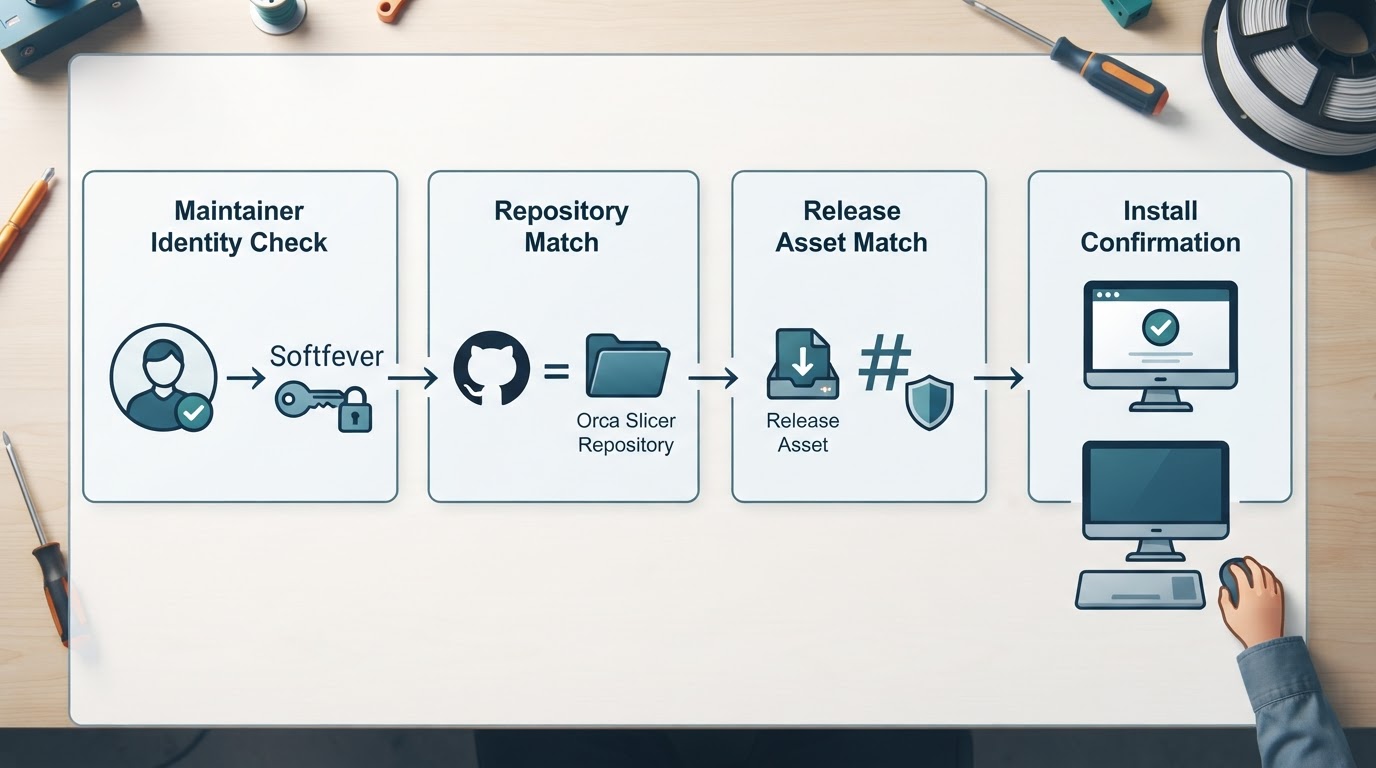
How to verify authenticity before you install
Use this checklist every time the search mix of GitHub, SoftFever, and OrcaSlicer leads you to a new page.
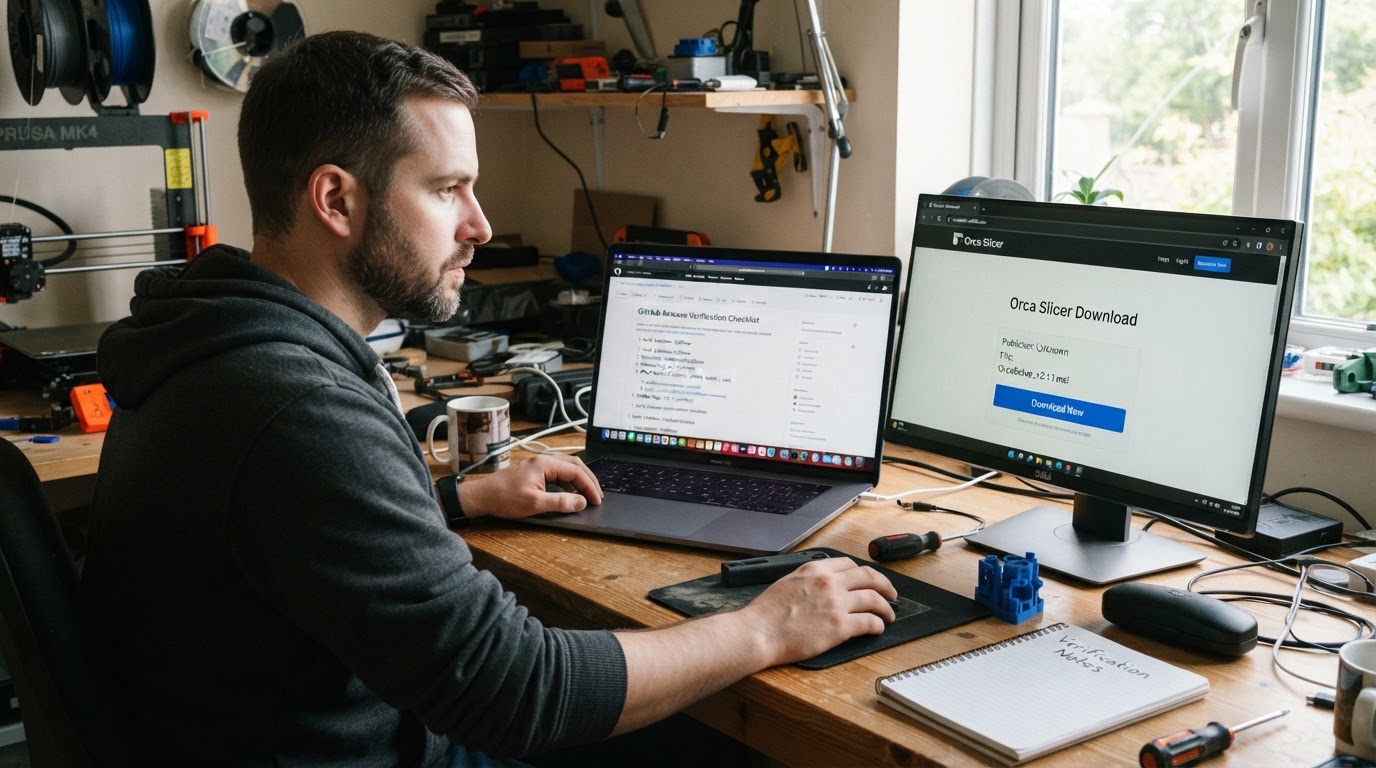
1. Separate the product name from the publisher
Ask: who published this page, and who published this file?
- The product name can appear on many domains.
- The publisher identity should stay consistent across the repository, release publisher, and any official site the project itself claims.
- A polished download landing page is not proof of authenticity.
2. Confirm the maintainer trail
On the live repository surface you open:
- Look for SoftFever (or the current maintainer identity the project itself presents) in the owner/committer/release history.
- Prefer a continuous public history over a brand-new mirror with the same logo.
- Be suspicious of accounts that only host installers and never show source history.
3. Match the file to a release, not a blog CTA
Before running an installer:
- Open the release entry that claims to provide the build.
- Confirm the asset name, platform, and release notes match what you intend to install.
- Prefer checksums, signatures, or other release-attached verification material when the project publishes them.
- Do not trust a compressed installer that arrived only through an ad block, outbound redirect, or unsolicited mirror.
4. Watch for lookalike distribution patterns
Common failure modes:
- domains that reuse the product name but never link a verifiable release identity
- “latest cracked / unlocked / full version” packaging language
- pages that host binaries while denying any connection to the public repository
- instructions that tell you to disable OS protections permanently just to run an unsigned random binary
Independent guide sites can still be useful for workflow teaching. They should not become a substitute for the project’s own release channel when the question is “which file is authentic?”
5. Re-check after install, before you trust profiles
Authenticity does not end at the installer:
- Confirm the app name, version string, and about/license surface match the release you chose.
- Create or import printer and filament profiles only after the binary itself looks right.
- Keep a note of which release you standardized on for the shop or fleet.
After authenticity: printer and filament profile setup
Once the binary is trustworthy, the remaining job is operational: get a printer profile and filament profile stack that matches the machine in front of you.
A durable setup order looks like this:
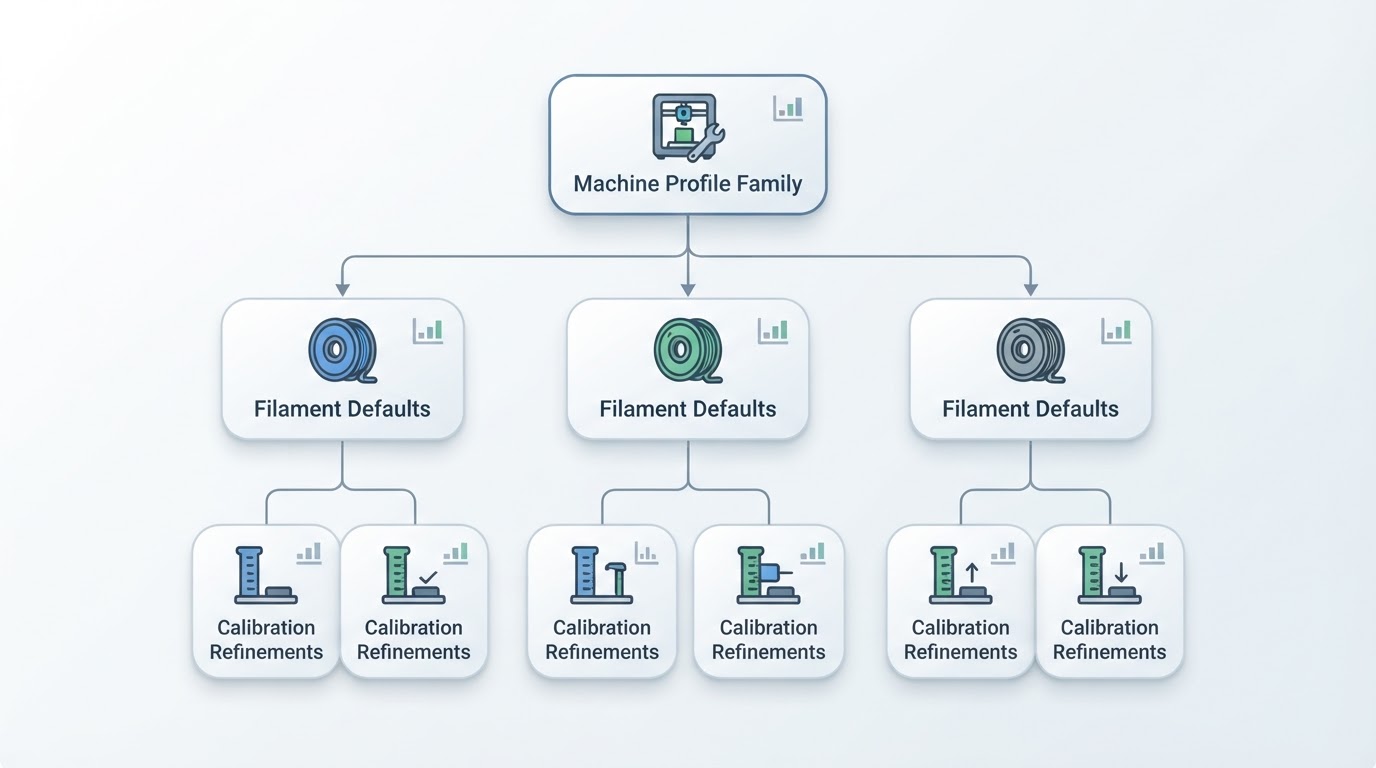
- Pick the machine profile family first. Start from a maintained profile closest to your printer kinematics and firmware class rather than inventing every speed from scratch.
- Lock filament defaults second. Temperatures, cooling, flow-related limits, and material-specific constraints belong in the filament profile so they can move with the spool.
- Calibrate only after the profile baseline is sane. Flow, pressure advance, retraction, and max volumetric limits are refinement steps, not a substitute for choosing the wrong machine family.
- Save a known-good preset pair. Fleet operators should be able to answer “which release + which printer preset + which filament preset printed this job?”
- Re-validate after any slicer upgrade. A new release can change defaults; authenticity gets you the right app, but profile drift still needs a quick reprint check on a small coupon or first-layer test.
This is where multi-brand and Klipper/Voron users usually get stuck: the GitHub authenticity question is solved, then the machine still needs a profile path that survives the next filament swap. Keep those two problems separate. First trust the build. Then standardize the profile pair.
A completion standard you can reuse
You are done with the orca slicer github softfever evaluation when all of the following are true:
- You can explain SoftFever as the maintainer/origin identity associated with OrcaSlicer, not as a free-floating “download brand.”
- You can point to the live repository/release surface you trusted and explain why.
- The installed binary matches that release identity on platform and version labeling.
- You have a first printer profile and filament profile pair ready for a low-risk test print.
- You know what would force a re-check: a new mirror, a redirected installer, or an unexpected publisher name.
If any row fails, stop at verification. Do not “just install it” because the page used the right product nouns.
How Orca Slicer fits this job
Orca Slicer is useful here as an independent guide layer after you already know how to verify upstream authenticity. Our job is to help you make the next decision—release channel discipline, profile setup order, calibration sequence, and multi-brand fleet habits—without pretending to be the official project or hosting the installer.
That split is intentional:
- Official project surfaces answer “is this the real OrcaSlicer lineage and release?”
- Independent documentation answers “now that I have a trusted build, how do I run it well on my printers?”
If a page collapses those two jobs into one aggressive download CTA, slow down. Origin questions deserve a verification path. Profile questions deserve a setup path. Mixing them is how lookalike distribution wins.
Common mistakes to avoid
- Treating every GitHub fork that mentions SoftFever as equivalent to the project you intended.
- Installing first and reverse-engineering authenticity later.
- Copying printer profiles from random screenshots before confirming the slicer build.
- Assuming “open source” means every mirror is safe.
- Upgrading mid-job queue because a pre-release fixed one bug you have not reproduced.
Bottom line
The useful reading of orca slicer github softfever is navigational and commercial at once: identify the SoftFever-linked OrcaSlicer origin trail, take builds only from a release surface you can defend, and only then invest time in printer/filament profiles. Keep SoftFever, OrcaSlicer, GitHub Releases, and third-party guides in separate mental buckets. When those buckets stay separate, authenticity checks get shorter and profile work gets safer.